

Are There Even Any Value Differences At All?
You can distinguish your facts from my butt
1.
One time, long ago, probably before you were even born, Scott Alexander wrote that “Fundamental Value Differences Are Not That Fundamental.”
The argument goes that even people who say they disagree with you on some important moral stance are actually probably much less principled and more persuadable than they seem. Scott cites examples like nativists saying that a country only has responsibilities to its own citizens, and then turning around and supporting disaster relief for other countries.
Clearly, even though they claim to hold some principle very strongly, they’re willing to violate it given the right circumstances. Scott concludes that value differences tend to be “continuous” rather than “fundamental”—some people are more nativ-ish, some less, and it might not be so hard to persuade the people nearest to you on the bell curve.
I’m sympathetic to this conclusion; it definitely wins more intuition points than “my enemies are all irredeemably evil.”
Unfortunately, I think it might not do quite as well as a view which says “my enemies all believe really silly things about the world.”
2.
I’m going to start with the easiest example I can, and the one that turned me on to all this.
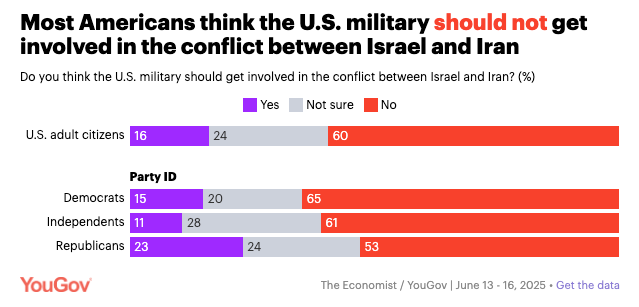
Last week, before Trump struck Iran, DeepLeftAnalysis🔸 wrote a piece which referenced a couple polls asking Republicans whether or not he should do it. One, from YouGov, showed just 23% in favor:
And another, from CNN, showed just 27% opposed:
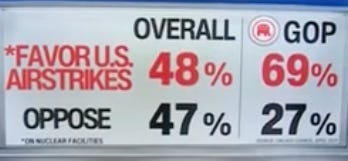
Why the disparity? Well, I’ve been a little dishonest with my cropping—the CNN poll actually asked…
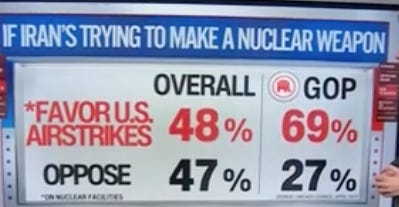
It was conditional on some fact about the world!
I think this reveals something interesting: for most Republicans, at least, the question wasn’t about “America First” vs. “Blow Up The Muslims,” it was a matter of whether Iran was going for the bomb or not—and, if they were, the Republicans were very friendly to blowing them up.
The results of a Washington Post poll pointed in this direction too. They asked respondents whether they wanted to strike Iran or not, and also how much attention they’d been paying to the news lately:
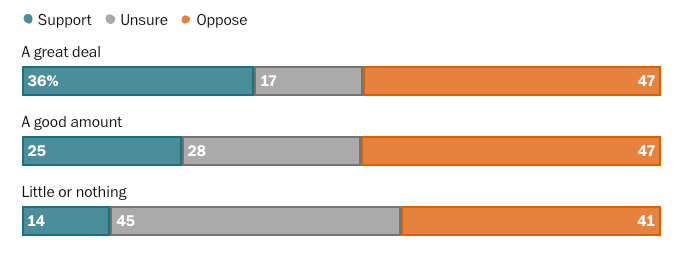
Given that news coverage was altogether pretty friendly to the idea that Iran was close to, or pushing for, a bomb, I think this points in a pretty similar direction.
Why is there a large contingent (47% per both CNN and the Post) who think bombing Iran is a bad idea no matter what? Probably they think that it wouldn’t accomplish much, or it would pull us into some kind of Iraq-style forever war, or they remember how Saddam was “trying to make a nuclear weapon,” and fuck you, Mr. Pollster, it’s all propaganda anyway. But those are all still factual beliefs, not value differences!
2.5.
This is a brief interlude to point out that if moral realism is true, I win by default. Any value difference will reduce to a statement like “X is good” and if there’s a fact-of-the-matter about whether or not X is good, then even that’s not really a value difference.
But obviously that’s pedantic and annoying and controversial, so we’ll set it aside…
3.
Does my Iran example generalize at all?
I think so! Take the foreign aid case from before: when a diehard nativist supports disaster relief, are they being continuously-value-different? Or is it possible that they have a long list in their head of mostly-agreeable conditionals like, “if the aid can be distributed non-corruptly, and if there’s no better use for it at home, and if it doesn’t massively decrease trust in our government which derives its support from the people, and… then it’s good to give it.”
The latter seems totally plausible! And if you’re arguing with a person like that, probably the best thing to do is trot out lots of studies that show how effective and non-corrupt and non-trust-destroying most normal foreign aid is.
As far as I can tell, this is a lot of what Effective Altruists try to do. So why hasn’t it worked?
Ehh… bias, is my answer. Bias and faulty reasoning and what I’m calling “self-ideological-capture” until I can come up with a better name for it.
Everyone wants to think they’re principled; this is true even on a very fundamental level—the brain knows that strict, straightforward heuristics are cheaper to maintain than costlier ones, so it favors them a bit.
And so even if a universally-held list of conditionals is in there, lurking deep down, people will just reference their active worldview once, check which direction of the zeitgeist the list generally points based on it, declare themselves a That-Way-ist, and then try not to ever change their worldview too much, lest they feel compelled to re-run the test.
4.
…Hold on, does this just cash out to value difference again?
Like, if there’s something stopping people from changing their worldview, re-running their test, and integrating the new results, what do we call that thing if not “value”?
There’s some kind of social or mental-coherence cost to doing the refresh, and so a second-order preference not to do it. And since the second-order preference has a lot to do with social pressure, it makes sense that it’d take a socio-ideological kind of form, and start to look like a “value.” And then because it has a lot to do with mental pressure, it’ll become stickier and start to look more “fundamental.”
…But there’s a sort of chicken-and-egg issue here: if social pressure dictates value-formation, where does that evaluative social pressure come from in the first place?
My guess: fact-based memes. Someone has a particularly good and compelling story about the nature of reality, they convince enough people to take on their worldview, those people run it through their lists and become strict That-Story-ists, and it snowballs from there.
I don’t know if you have a particularly good reason to believe all of this. I mean, it’d certainly be nice to sincerely think that we’re all just one big happy family, everyone’s out for the same good, we just have different maps of the territory, and all you have to do is make your map the best-selling one—but I’m not sure you even have a right to think that. Because your map might also be bad, outdated, and distorted! In fact, it almost certainly is—you’re subject to all the same biases and fallibilities as everyone else.
The best lesson I can offer is that learning is good, Overcoming Bias is good, and you should mostly try to assume that people mean well. None of this is all that revolutionary… but it was fairly fun to write.

I think your point about Iran is great, but generalization is a bit off. Tl;dr; I do not believe in checklists, rather in conflict between different values, as Berlin bequeathed.
There is multiple things going on here. First, Scott says that there is a continious line between nativist and inteventionist, which determins how open you are to foreign aid. Second, he argues that "[the world is] made of a giant mishmash of provisional things that solidify into values at some point".
The second is a great point. You narrow it a bit in your essay to "fact-based memes" that people run through their lists, but IMO Scott interpretation is more correct. I became consciously Zionist probably at the age of 10-12 (not Jewish). I definetely didn't run tests on Zionism to check if it's a good idea; rather, I grew up in Russia, happened to be drawn to liberal ideals, many Russian liberals are Jews, so I just got support for Israel as an extra. For other people, it may be even less formed: somebody may be a Zionist because his girlfriend is Jewish, or because first essay they read on the topic was arguing this point. I eventually got better reasons to support Israel, but that happened much later. Anecdotally, I would assume it is more common to just adopt the same ideas as your friends than actually think about them.
On the other hand, great point about Iran debate being about nukes, not about nativism vs interventionism. Scott shouldn't have flattened "mishmash" into a line. Real world is complicated, and as Isaiah Berlin noted, even your good values would likely come to conflict: in this case, "anti-war" is pulling towards nativism, while "anti-nukes for Axis of Evil" is pulling towards interventionism. Or less beningly, you may be pro-Mexican immigration, because you want cheap labor, your personal experience with Mexicans is nice, and you watched a touching movie about them, but against Muslim immigration, because you think they chant "globalize the Intifada" too often. It's not really a point on interventionist-nativist line, but rather a bunch of motivations, some a good and some are bad, that may or may not apply to each particular case.
Which also explains why checklists don't work. Japanese are more sympathetic, Western, allied, portrayed as hard-working, suffered a natural disasters, and, yes, less corrupt than most African countries. This together could outweight general lack of desire to send money abroad. African countries with their permanent state of destitution is a different thing. Even if you come up with the studies to cross the corruption argument, you won't make people like the country they won't even be able to find on the map more.
This feels like a sloppier version of Haidt's Moral Intuitionism. You center facts in the story more than he does, but your notion of fact-meme seems very close to his notion that there are trusted people/groups who we trust for various reasons, and so what they express about reality is the stuff we trust to guide us.