

The Future of Conservatism Is Looking a Little Bleak
Reflections on the Buckley Institute's Annual Conference

1. The Present of American Conservatism
Last Friday, November 14, I spent my afternoon and evening at the Omni New Haven Hotel, attending the William F. Buckley Jr. Institute’s 15th Annual Conference. The keynote speaker was to be Ron DeSantis, and CNN’s token conservative, Scott Jennings, would debate Noah Rothman, a writer at National Review, over whether Trump is in fact a conservative.
There was a career fair, a networking-hour, lots of cheese to eat, and a couple panels surveying Bill Buckley’s life, and reflecting on his fusionist program in the light of modern right-wing politics.
I was excited! To be sure, I’m more a libertarian than a conservative — in no world would this be more intellectually or socially stimulating than Cato University — but I like the right-wing campus community, and the most Buckleyan corners of it especially.
The event’s primary theme, too, was attractive: “The Future of American Conservatism.”
I was feeling pessimistic about that future — the day before, I’d published an article in the Buckley Beacon (a campus paper associated with the Institute), entitled “The Conservative Civil War Is Coming to Campus.”
In the wake of three dramatic and interrelated events — the appearance of Nazist language in the pages of a conservative magazine at Harvard called The Salient, the discovery of “I love Hitler”–themed Young Republicans group chats, and Tucker Carlson’s surprisingly chummy interview with Nick Fuentes, famous kookypants — I worried that the furthest, most fascistic fringes of the right-wing were beginning to threaten the existing conservative coalition.
Plenty of others were concerned about this too — and, I wrote, they tended to have “a confident prescription for any conservative leaders still repulsed by Fuentes’ brand of antisemitic reaction: deplatform him! Expel him! Make like a Buckley, and banish the Bircher!”
But I worried this wouldn’t be so feasible:
Buckley controlled the conservative means of communication. He could excommunicate the John Birch Society because he could drive its people out of newsrooms and broadcasters, he could keep them from their audience. But today the media landscape is utterly decentralized, and Carlson and Fuentes have millions of adoring fans who can’t be cut off.
It’s clearly good and right, on a personal, social, and institutional level, to shun the ideas and figures of the Nazi-sympathizing fringe. But we can’t count on this alone. Fuentes will keep streaming, the Young Republicans will keep texting, and if you try to shut The Salient down, they’ll fight hard to keep publishing.
We’ve got to do a little more: we’ve got to win arguments and change minds, too.
And so I walked into the Omni New Haven Hotel ready, if not to have those arguments, then at least to prepare for them. I expected the panels and speakers to name the threat — the aggressively anti-Buckleyan, radical and revolutionary right-wing — and offer some means by which we might fight it off.
But I was sorely disappointed.
2. The Indefeasible Desire to Retvrn
First was a lunchtime panel, three scholars were asked “What defines conservatism?”
…And then they talked for an hour about the French Revolution, and how very bad it was, how it epitomized not-conservatism, and conservatism mostly was just defined by not-that, by not-not-conservatism. Asked to express their case in more positive terms, the three mostly pointed at how radical all our traditional values were at the time: Michael McConnell spoke about the Enlightenment ideals of the American founding. Peter Berkowitz pointed to Buckley’s anti-statism in opposition to the Soviet Union internationally, and the New Deal consensus at home. Charles Cooke suggested that God and Man at Yale was a radically anti-elite text.
This was all pretty unsatisfying — did conservatism simply mean conformity to successful revolutionary values?
Yes, answered the panel! And to oppose those values would be utterly nihilistic, and also naively utopian.
Then they spent some time reflecting on how wonderful fusionism was, and how successful the conservative legal movement has been in the last few decades.
I think any Fuentes-fan who attended this panel would’ve left thinking, “Yeah. Yeah, this is what we need to burn down. These guys have totally lost touch, and the next righteous, successful, proper revolution will be mine.”
A few of Bill Buckley’s acquaintances came in next; they spoke for an hour about how cool and nice and smart and music-lovin’ the old man was. Also, how fun all his dinner parties were. (I’m not sure if it ever got more substantive; pretty soon I got bored, and stepped out into the career-fair area for most of that discussion.)

I was late to the next event — got lost, since it turned out there had been two rooms booked for the affair — but showed up just in time for the “Fusionism, Fractures, and the Conservatism of the Future” panel to mention the Fuentes kerfuffle… only to dismiss it, and clarify that their conversation would mostly be about the Trumpian wave of anti-fusionism. You know, the one which was shocking and newsworthy in ~2015!
The session was rife with 20th-century metaphors: the first Trump presidency was like if Goldwater won in ‘64 — before that election, Buckley had remarked, supposedly, that “we’re not ready to win.”1 And the big question for conservatives to deal with today is, of course, same as the one which faced ol’ Russell Kirk in the 1970s — how to properly balance liberty with order.
“Who’ll succeed Trump?” the moderator asked. Steven Hayward quickly analogized the President to 20th-century French statesman Charles De Gaulle — also a charismatic, egotistical, unprincipled, extremely popular jerk — and then said something like, “Yeah, no one really knew who was gonna succeed De Gaulle either,” and stopped talking.
Eugene Meyer, president of the Federalist Society, acknowledged that MAGA is driven by a fierce anti-elitism, and then suggested that maybe Reagan-style neoliberalism is the solution. The moderator pointed to how bad the Tea Party had flamed out. Meyer reiterated that the Reaganite ideas are very good.
“Fiscal restraint, anyone?” asked Hayward.
Someone in the audience wondered whether there was a conservative mandate to fight Islamofascism. A panelist said yes, Islamofascism is bad, but also one time I was in a cab and the driver was the president of Muslims for Romney, or something, and that was pretty cool, so maybe the Muslims are alright after all.
The Fuentes in the back of my head said, “Do you see? Do you see what’s going on here? They’re stuck in the cosmopolitan libcuck ideology of the past, they love the Muslims, they won’t stand up for the West — oh, and that one named Eugene Meyer? Meyer? Come on man!”
The final panel asked, “Can Conservatives Reclaim the Culture?” Mostly the hour consisted of National Review art critic Brian T. Allen complaining about some woke exhibit at the Yale Center for British Art, and urging museum directors to Make Curation Apolitical Again.
My inner Fuentes raged and frothed and looked at pictures of cathedrals on his phone.2
3. Conservatism Is a Loser
Lots of folks showed up just for the debate; all of a sudden the cheese table became very hard to access.
The topic was “Resolved, that the Trump Agenda Is Conservative,” Scott Jennings took the affirmative, and immediately conceded that Trump often acts in ways no sane person could describe as conservative. Well, he did do some conservative things — appointed Originalist judges, cut taxes, went after the Deep State. But also he’s been tariff-y and isolationist and erratic — in Jenning’s terminology, Trump has been “not just conservative, but transformational.”
Noah Rothman spoke very quickly, and honestly I didn’t catch all of what he said, but the gist was, “Yeah, the ‘transformational’ bit is very much at odds with the ‘conservative’ thing, and also RFK and the rest of the cabinet are all lunatics, what even is there to argue about here?”
Jennings suggested that maybe the transformational bits were political necessities, and no Republican could get elected nowadays without promising to do some crazy shit, and hell, he’s been better than a Democrat would’ve been, right?
From there the debate descended into a completely unproductive conversation over whether it’s more important to be philosophically pure, or politically successful. Rothman, half-joking, declared himself an “ideological zealot,” and Scott Jennings started reciting campaignish applause lines.
This experience depressed me very much — I came into it mostly on Rothman’s side, unwilling to compromise with anti-market right-wing nutjobs. …But he lost the debate. He was unconvincing, and came off impractical and stubborn, whereas Jennings promised a win for Team Red, seemed confident that a JD Vance–type could unite the coalition satisfactorily. The room was on Jennings’ side, and even my inner Fuentes was a bit soothed when he celebrated the deportation of international students who “engage in activity aimed at the downfall of Western civilization.”
Now, I still dream that the most libertarian-leaning of the fusionists will somehow join forces with the Abundance Libs and elect Richard Hanania to Make America Elite Human Capital Again… but I’m more skeptical than ever that there’s real political energy behind such a platform.
For one thing, there aren’t many libertarian-leaning fusionists left! The extent to which postliberalism has won hearts and minds among the right-wing elite is difficult to overstate: Ron DeSantis’ speech spent a bit of time defending pro-market policies in Florida, but a lot more beating the anti-woke, “New College has an awesome baseball team now” drum. He even spoke a few lines about his utterly retarded plan to get rid of property taxes on private residences in the state, which received a tremendous applause.
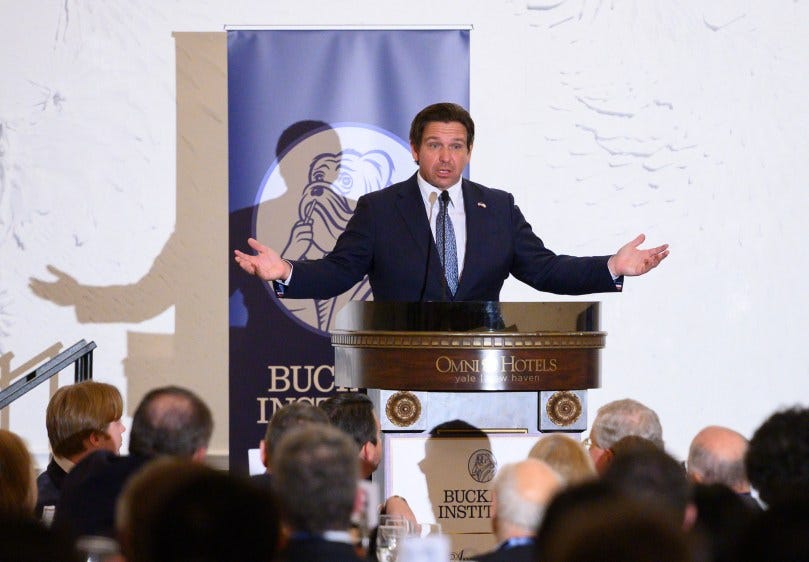
If anything, the speech was an ultimate vindication of all Scott Jennings had said: DeSantis really did do some laudable conservative things — opened schools and businesses during COVID, cut taxes, busted the teachers’ unions — but he could only defend it all in culture-war terms. Florida didn’t merely hire law & order prosecutors, it “beat George Soros on crime”! It couldn’t just crack down on illiberalism in classrooms and universities, it had to “ban DEI” altogether; had to kneecap tenure protections and academic freedoms.
These were the lines which received the loudest cheers, and this is why DeSantis won reelection by nearly 20 points. Postliberal resentment politics are already in — the question is whether they’ll continue to cohere at all with the American conservative tradition.
4. Kill the Nazi in Him, and Save the Conservative
The problem with the Buckley Institute — and I bet the Federalist Society, and a thousand other intellectual right-wing campus organizations, too — is its utter unwillingness to be relevant or practical in the slightest.
Whether or not Trump is a conservative — and whether or not the distinction matters — was an interesting right-wing conversation about a decade ago. Today, the debates have got to be about today’s frontier: Nick Fuentes and his brand of right-wing identity politics.
In particular, we ought to be asking if ideological purity has a shot of winning this time around — and if not, which parts of the Groyper platform are just palatable enough to adopt out of political expedience.
It seems like Richard Hanania is about the only guy asking these questions, and I don’t think his answers are good enough. For instance, he suggests:
For conservatives, you can note that if they’re going to believe in populist economics they need to go full statist to maintain logical consistency. And if they decide that in that case markets are bad, then it becomes an easy decision to support the left, since the two sides will be similar in their economic thinking but one of them at the very least will be smarter and less racist.
…Which is Rothman-style zealotry, and probably unappealing both to the median voter and to the average Deneen-pilled elite Yale “conservative.” It’s not better to be “smarter and less racist”3 — the resentment over disappearing manufacturing jobs and fentanyl deaths and the crisis of male unemployment, depression, and sexual inactivity is a real political force, and Democrats have a nasty habit of saying things like “Young men need to save themselves,” or “men must continuously and unequivocally hold other men accountable,” or “Women Can Have Penises Too,” which is why they lose all the elections.
If principled conservatives go over to the out-of-touch, “Y Chromosome Is Dysgenic” side, who’ll be left behind in the right-wing party they’re gonna start losing to? The loonies!
No, better to maintain some kind of a moderating presence. Especially within elite institutions, it’s important. There aren’t a ton of Fuentes-tempted rightists around here, but there are a few, and they really do tend to be talented and highly motivated people. They’re the ones who you’ve got to be worried about — without them, you get a Trump-first-term-style reliance on entrenched, saner interests. With them, you get a full-scale assault on the Great Experiment itself.
It really is dangerous to abandon these few people to generate their own monocultures — I have it on fairly good authority that this is what happened at The Harvard Salient: a group of fringe rightists seized control of the institution and quickly began publishing Nazi rhetoric. The failure mode very much exists!
That said — I don’t know if I can point to any real success-modes. I’m not sure anyone knows how to keep the coalition from fraying — maybe a harder pivot toward postliberalism? Maybe abandoning Israel? Maybe taking more group bowling trips?
I wish the Buckley Conference had given me some answers — but it failed to even acknowledge the questions’ existence. For now, we forge on blindly.
Closest thing to this I could find online was a book about Trump’s first term which had this to say:
Donald Trump and his tiny band of campaign warriors were ready to lose with fire and fury. They were not ready to win.
So, close enough, I figure.
While masturbating furiously.
Do not take this quote of context.
The Buckley things (/people) are generally much less intelligent or interesting than one would like!
Props to you for doing the full day lol
This has been my experience as well. Ossified organizations ostriching. I think millennials/gen z are going to seize the reins of power from the boomers soon, in a fairly big upheaval of an ~5 year span. It’s only really happening on the fringes so far, but it’s starting to creep inwards. That’s the subtext of Zohran and Fuentes. I can only hope that dynamism comes to the sensible portions of the spectrum before they get eaten by the populists.