

The Problem with Objectification
Attractiveness is impersonal

I had what I thought was a really clever realization in the shower: ‘Oh, women dislike objectification because attractiveness is too impersonal!’ And then I wrote this and realized that my conclusion was basically ‘objectification is bad because it’s objectifying.’
Oh well, too much time spent not to publish.
I’m a man, almost, and I’ve had some romantic experiences. I’ve found that in the course of those experiences, I really don’t mind being objectified.
And, I should clarify, I don’t just mean being complimented. Being complimented is great, but everyone already likes it, there’s nothing interesting there. Objectification has some extra demeaning-ness to it. It’s a compliment that’s totally superficial, even reductive.
But really, I don’t mind it. Usually, I like it. And I don’t think I’m alone in this respect: whenever women complain about being endlessly objectified, most men’s knee-jerk response is: “so what? I’d kill to have women randomly coming up to me and telling me how good I looked.”
Of course, the fact is that women do complain about being objectified, and it’d be strange to dismiss someone’s complaining about their own subjective experience, so we should begin by assuming that women really do find it unpleasant. For some reason, they tend not to like being told how good they look—or at least don’t like it nearly as much as men do.
Why? I can think of a few theories:
1. Women only like being told how good they look by men they like
This idea is best expressed by the meme:
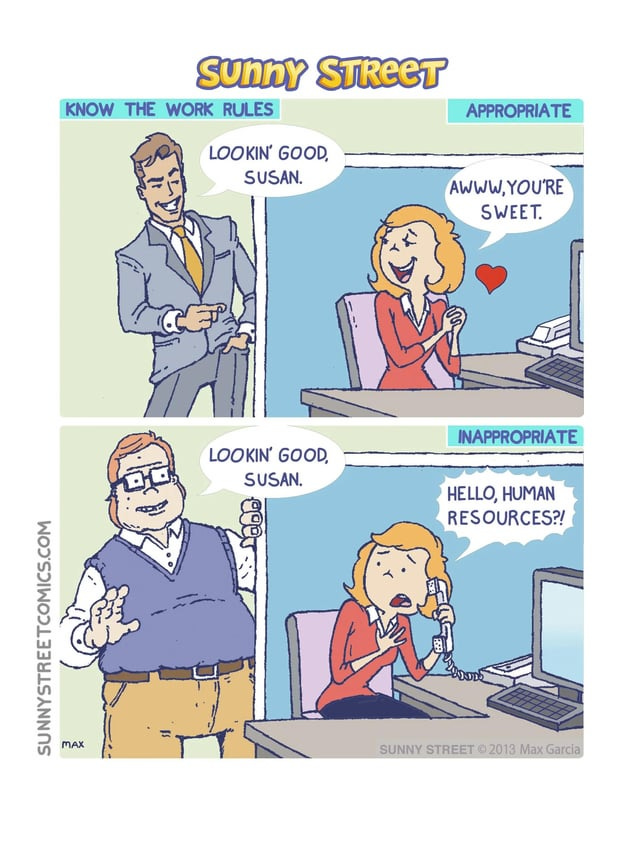
I think it’s most supported by incel-types whose experiences resemble that of the second man. Of consistent rejection using the same lines and same strategies as successfully dating men (who happen to look like the first guy).
There’s certainly some truth to this. Attractiveness works in favor of the attractive in myriad ways: hot people are more popular, more successful, and just generally happier than everyone else—and stratification between the hot, the less-hot, and the not-hot starts as early as high school.1
But I don’t think this explains it all. There are plenty of strong, independent woman–feminist types who will bristle at a stranger of any level of attractiveness approaching with objectifying language.
And men don’t really mind being complimented on their looks by women who aren’t hot. Sure, probably more sexual capital is gained upon hearing an objectifying remark from a better-looking woman—but we’ll take whatever we can get. In contrast, women react to objectification not with grudging acceptance, but with outright rejection. The disparity remains unexplained.
2. Women don’t like the cold approach, period
For the strongest expression of this belief, see Schrödinger’s Rapist, an old radical feminist piece by Phaedra Starling. Some relevant quotes:
“some men should never approach strange women in public. Specifically, if you have truly unusual standards of personal cleanliness, if you are the prophet of your own religion, or if you have tattoos of gang symbols or Technicolor cockroaches all over your face and neck, you are just never going to get a good response approaching a woman cold. That doesn’t mean you’re doomed to a life of solitude, but I suggest you start with internet dating”
This is clearly connected to theory 1: for some people, cold approach with superficial compliments is just never an option. But, even if you’re at least decent-looking, Starling clarifies that you probably still shouldn’t be doing a cold approach:
“You want to say Hi to the cute girl on the subway. How will she react? Fortunately, I can tell you with some certainty, because she’s already sending messages to you. Looking out the window, reading a book, working on a computer, arms folded across chest, body away from you = do not disturb. So, y’know, don’t disturb her. Really. Even to say that you like her hair, shoes, or book. A compliment is not always a reason for women to smile and say thank you. You are a threat, remember? You are Schrödinger’s Rapist”
Of course, as Lirpa Strike notes in her wonderful article, Did Feminism Ruin Dating?:
“I almost never use public transportation without finding a way to occupy myself while I’m on it — usually by reading something or looking out the window. My arms are usually across my chest or similarly positioned because that’s a perfectly normal way to sit when you’re alone on a subway or bus or airplane, especially if it’s crowded, and sometimes it’s actually kind of cold in there.”
If we’re to follow Starling’s advice—to only approach a woman with compliments when she has particularly encouraging body language—then, per Strike, we’ll probably never end up doing that. I don’t think Starling is overestimating the likelihood of an interested woman having welcoming posture—I think she’s simply stating her belief that nearly all women nearly all the time don’t want to be approached by anyone.
Of course, her claim is that this is entirely justified: women are sometimes raped! They’re on high alert, and see a man approaching with a comment about their body as an obvious threat. Why is that?
3. Attractive women don’t want you to care about their attractiveness
Evolutionary psychology makes one big claim about human mating practices: it says that men are after sex and women are after relationships. Both men and women care about reproducing successfully—but that comes at a much lower cost for men. After (successfully reproductive) sex, a man will have fertilized an egg, creating a new organism sharing his DNA. A woman will have done the same, but she’ll also be something the man is not: pregnant.
She’ll be knocked out of commission for at least six months of pregnancy, and probably a few months afterward too. Then she’ll have a kid that’s obviously hers, that she’s on the hook for supporting. Meanwhile, the man can move on, deny the kid is his, and go inseminate more women.
In order to increase her own likelihood of surviving and being able to have more kids, the woman would probably prefer some guarantee that the man will stick around and help her during and after pregnancy. That guarantee is a romantic relationship.2
When someone is complimented on their appearance, it sends them a signal to update their own estimate of their sexual fitness, as well as indicating that the complimenter is (probably) interested in them. For men, these are both very positive signals that make him like the complimenter more—they indicate that he’s closer to having sex with this particular woman, and also that he’s more likely to have sex in general.
For a woman, however there’s a subtext. Since attractiveness is such an objective and ultimately impersonal feature, when she hears a man say “you’re hot,” she hears, “I like having sex with hot women, and you’re hot, so I want to have sex with you, Hot Woman,” not “I want to have a relationship with you, Jane Doe.” Throw in the fact that some women are, in fact, conditioned to think of men as dangerous, potential attackers, she might even hear, “I want to rape you.”
Jane Doe thinks that if she ends up having sex with this man, it’s significantly less likely he’ll stick around for the pregnancy and birth.3 She’d much rather have sex with a man who effectively signals his willingness to enter a relationship and commit to her emotional and physical health.
So a man who really is interested in that will have more success complimenting a more personal feature. If Jane spends time styling her hair in a distinctive way, complimenting it will work better than commenting on her physique. If she’s reading her favorite book across from you on the subway, asking her about it will do more good than telling her she’s cute.
Really, incels be damned, women who date are in a much more precarious position than men who do. It’s a fundamental truth about human sexual relations: women have a lot more to lose if they pick the wrong partner. Objectification sends a signal that you don’t much care about the particular woman you’re talking to—you just care about having sex.
Men, on the other hand, just like to hear that they have high sexual capital. Our privileged stature in the evo-psych sexual market actually makes it much easier to pick us up—most women know that they can compliment a man just about any way they like, and he’ll eat it up.
Men don’t have that luxury in the modern dating market, and so we have red-pilled reactionaries coming up with get-sex-quick schemes. Until they fully accept that objectification won’t work—that women want relationships, not just sex—they’ll only get angrier and redder-pilled.
As Evo Psych tends to encourage, I’m making really big sweeping statements that aren’t accurate to how most people engage in their lives. Many men (myself included) really like to be in romantic relationships, to connect with their partners, and all that. And most women enter romantic relationships for those same love-based reasons, not because they’re scheming to entrap men and force them to be present fathers. But the underlying psychological pressures are what I’m trying to get across. It’s simply true that, in surveys, men are far more open to engaging in casual sex than women are. As a result, women immersed in hookup culture report higher rates of regret and loneliness than men. Women want relationships, men want sex.
Yeah, contraceptives complicate this a bit. But again, these are mostly fundamental evolutionary pressures operating on a subconscious level—they don’t know what condoms or Plan B are.