

My Bystander Intervention Training
On the soul-sucking depravity of the "workshop"

Today I am more thankful for the vibe shift than I ever have been before.
I am thankful for the relative rarity of my interaction with administrators and bureaucrats and peer-facilitators and community-educators. I am thankful to have escaped the anti-racist struggle sessions. I am thankful that requests for pronouns are accompanied, now, by an “if you want to share.”
I am thankful to have been subjected, over the course of my freshman year, to only two workshops.
1. And I waterd it in fears,
The last time such an injustice was visited upon me, it came with several ameliorating characteristics. First, the weather: early October is not an especially pleasant time of year, but when the leaves are all fiery red and gold, and the air is no colder than “crisp,” a fifteen-minute slow-group-walk across campus is more than tolerable. But in a barren 20° January, it becomes a torture — my ears and cheeks stayed pink throughout this most recent workshop.
Second, in October, my workshop-compatriots were generally bright-faced and cheery, good-humored new students. Their shenanigans made us “the most unserious group” of our workshop-facilitator’s tenure. Yesterday, my group was stressed, somber, and peeved.
Finally, and most importantly, any complaints I had about the last training — the one focused only on telling us not to do sexual misconduct — had a strong foundation in empirical research. Trainings like that one just don’t work — my hatred of it was completely adaptive and proper.
Mandatory Bystander Intervention Trainings, on the other hand, have got a fairly sterling record. To ground my spiritual frustration in the material would be a more substantial challenge.
Or so I thought.
The reality of this Mandatory Bystander Intervention Training has in fact imbued me with what is sure to be an unhealthy degree of confidence in the total moral correctness of all my basest aggravations. That is to say: it sucked. It sucked so bad. And I hope to convince you of this through pure rhetoric — science be damned, feel now the pure cleansing heat of my pathos.
2. Night & morning with my tears;
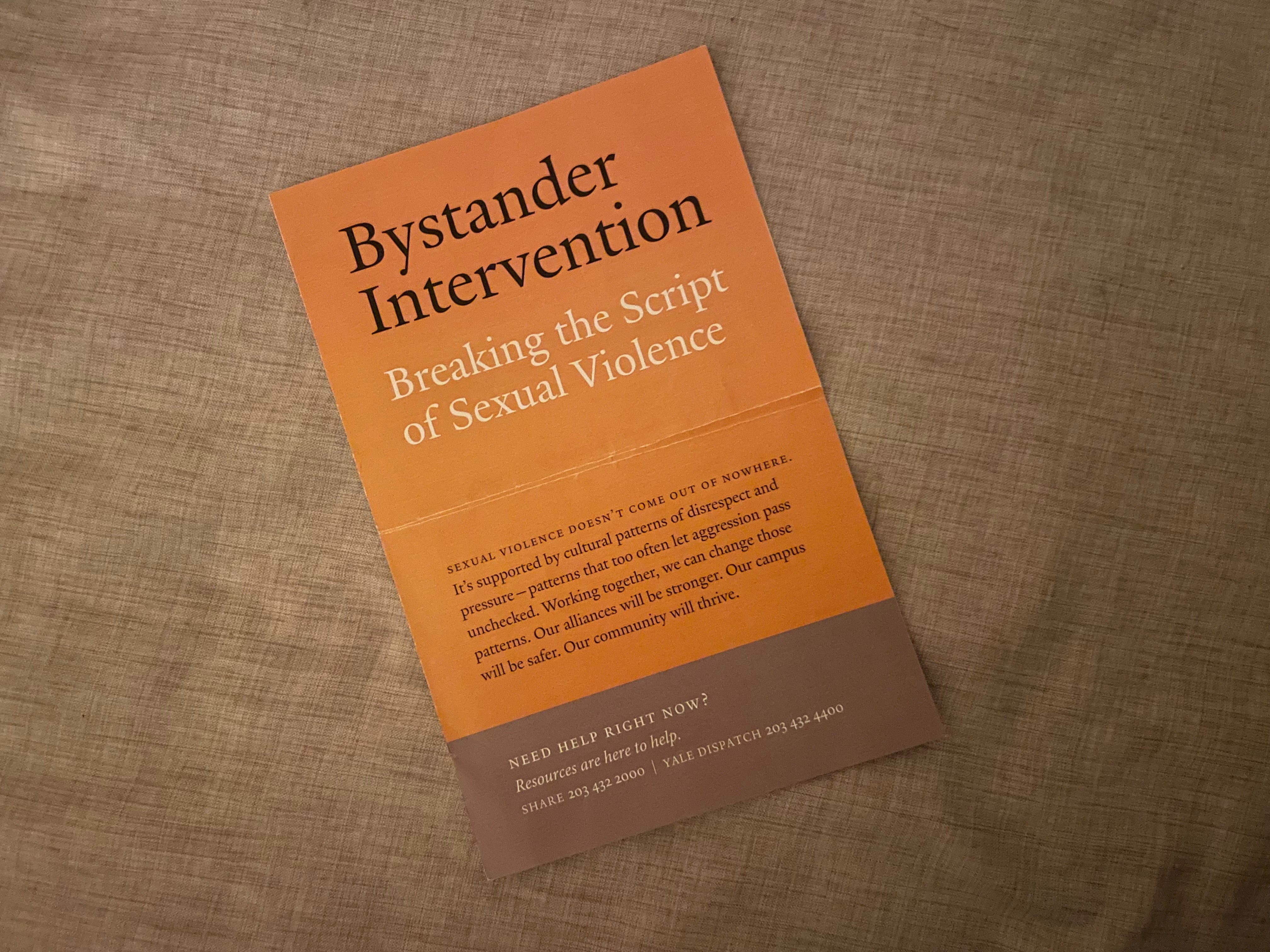
We were handed pamphlets at the start — “Bystander Intervention: Breaking the Script of Sexual Violence.” Our two Communication and Consent Educators (CCEs) turned down and began to monotonously recite their printed-out scripts.
The first scenario involved a suitemate, Sam, and an outsider, Casey. The latter was coming onto the former a bit aggressively at a party — Sam shot a nervous look at the proverbial you. What ought to be done?
Before you answer, thinking it might be something as easy and obvious as “go over and talk to your suitemate like a normal human being,” remember to refer to your pamphlet’s handy-dandy Steps to Action.
Pay Attention: Be alert to things that make you feel uncomfortable.
Well, in this context, “pay attention” means “look at the thing which the scripted scenario has already explained that you are looking at.” So good work!
Decide: Should someone intervene?
Well, maybe the context of a “Bystander Intervention Training” gives this one away… But in other contexts, where it might be less clear, the pamphlet provides some helpful diagnostic questions to ask yourself: “Is the situation worrisome?” “Does someone need help?”
Make a Plan: Fit your intervention to the situation.
In other words, don’t pull a Minneapolis-ICE-officer all over some poor workaday creep. And some further words of advice: “Be creative and strategic.”
Make it Happen: Stay calm. Follow your plan. Be ready to get help if you need it.
Yes folks, you heard it here first: intervention requires an act of intervening.
We followed the steps faithfully: observed Sam’s body language, decided to intervene, planned to approach Sam to talk to Sam, approached Sam and talked to Sam. So far, so good.
And then the facilitators upped the stakes on us: what if Sam were a bit drunk? What if Casey were an ex? What if they were trying to get Sam to go home with them?
We dutifully adjusted our four-step process to fit each new scenario. (These adjustments largely looked like, “do the same thing, but with a meaner face and a bit faster.” One girl ventured a stronger proposal: “If Sam’s drunk, then it’s automatically rape, right?” The prime-CCE shot her down: “Actually, we think people can maybe consent when they’re a little drunk, and it’s more about being aware of power dynamics and whatever.” Save for that hiccup, we passed this bit with flying colors.)
3. And I sunned it with smiles,
The CCEs formed us into groups of three or four, and passed out scenarios to each. Here they paused and explained that — like in the opening Sam / Casey scene — all of the names and pronouns we dealt with would be gender-neutral. This was important because sometimes people have crazy sexist stereotypes in their head, which make them think that a sober frat brother aggressively hitting on a drunk sorority sister is a meaningfully different situation from one with the sexes reversed. Such dangerous prejudices could only inhibit righteous Bystander Intervening.
My group’s scenario involved a Riley and a Taylor, who’d just started dating. Riley was a suitemate of the proverbial you, and Taylor was hanging out in the dorm a lot, even when Riley wasn’t around.
At this point, I started joking around with the other two guys who made up my group. We got the customary, this is stupid, I don’t want to be heres, out of the way first, and then — just to kind of be a dick — I asked who they thought was the boy, and who the girl in the scenario.
“Isn’t Taylor just a girl’s name?” one asked.
“Ha, yeah, I dunno.” I said. “Or maybe they’re both guys! Doesn’t that change it, or something?”
We went on like this for ten or fifteen seconds, when the prime CCE — who’d apparently been listening in — came over to reprimand us for inquiring so sexistly into the identities of our characters.
I got into a little back and forth with her — “I know there’s this, like, desire to deny gender differences, sex differences in general,” I said, just to kind of be a dick. “But surely, you know, size and physicality are relevant? I mean obviously these things do matter!”
“I never said they weren’t relevant!” responded the CCE. Her co-facilitator called over, with a kind of edge in his voice, to ask if anything was wrong. “No no,” she said. Then turning to me, “Just, this is kind of tangential.”
“Yes,” I agreed, being a dick again, but this time more via tone. “Super tangential, I take it all back.”
4. And with soft, deceitful wiles.
We returned to our scenario. Its dramatic apogee came on a night when Riley returned home late, and tired. Taylor was there on the couch waiting for them, and said nothing but “Hey, let’s go to bed,” walking into Riley’s room. But the proverbial you saw Riley stay on the couch, not moving.
What was there to do? We returned to the big-group-all-together setting to share our answer. Feeling the dickishness and childish rage building up inside me, I leaned back and let another group-member share out. We would go up and talk to Riley, he said. Ask them what’s going on.
The CCEs gave us solemn nods. “Now time for the escalation,” the prime said. Riley was being distant and avoidant now. It seemed, wink wink, to have something to do with Taylor, wink wink, and the nature of their relationship, wink wink.
I just couldn’t stand it anymore.1 I rose — spiritually, not really, I’m not a psychotic — and I clearly and loudly said — I didn’t yell, I’m not a psychotic — “Be a friend! Isn’t it just that simple? Go up and talk to your friend! Ask what they’re feeling. Ask what they want. Why do we need this whole overtechnical procedure? Just be a damn friend!”
A sort of hush fell over the room.2 At the other end of the table, I could see an acquaintance of mine start chuckling — I think in a friendly and good-natured kind of way.3 I felt the wind-inflicted redness in my ears burn a little brighter. Something in me knew I should be embarrassed for my lack of self-control, but I couldn’t help grinning as I slouched back in my seat.
To her credit, the prime-CCE took my outburst in stride. “Yes,” she said. “It really is, in some ways, that simple! That’s what we’re here to tell you — that bystander intervention is pretty easy, pretty intuitive in the end.”
And maybe that’s a mission worth pursuing. Maybe that’s an understanding that some marginal number of undergraduates haven’t got. Maybe it helps to spend a mind-numbing hour realizing just how easy it is to act decently toward your fellow man. Maybe this was all great and dandy.
But I couldn’t help but feel extremely silly: made to attend this program oriented toward, essentially, proving just how worthless the program itself was.
I felt like a traveler in some strange city, who’d asked for directions to the bus station. And the local who I asked took me on a long and arduous trek, through a forest and over a brook and up a snow-capped mountain from which we looked down to where I was before. Then they pointed across the street from that place, and said to me, “There. It was just behind you, see? The bus station is there.”
Why couldn’t they simply have turned me around? Or even left me to make the discovery myself, after a minute or two of spinning and wandering?
You might be wondering, why? What the hell is wrong with this guy? Why does he let himself get so worked up over a silly little Mandatory Bystander Intervention Training; it’s just an hour of nonsense — what’s an hour, in the grand scheme of things!
I can only offer you this in the way of psychoanalysis: I think I’m pretty damn insecure. Like, about my intellect, and especially about the general perception of it. I want people to think I’m generally smart and interesting — I want them to act toward me like they would act toward someone who’s smart and interesting.
Not in an extreme way, mind you. I know, and know it on this same awkward semi-buried level, that I’m often stupid and/or boring. This is fine — it doesn’t hurt me to be treated like someone who’s often a bit stupid, often a bit boring.
What hurts me is to be treated like an idiot. Like a moron. A retard. Like someone who needs to be told that he ought “be alert to things that make [him] feel uncomfortable.” Like someone who needs a whole damn motherfucking framework, an hourlong lesson and a pamphlet, to intuit the link between “a bad thing is happening” and “I should intervene to stop the bad thing.”
I want just a modicum of respect. A damned iota.
I promise I’m not exaggerating for self-aggrandizing reasons. This really did happen. Pens stopped tapping, everyone kinda took a breath. It was pretty awesome.
Alternative hypothesis: people who are smarter and more socially adept and more, you know, at peace with themselves and the world than I am — they find it funny to get mad at this. They know you can’t win, you can’t escape. And instead of raging against this like an impotent fool, they’ve internalized and accepted this lesson. They’re totally zen, and it’s silly and embarrassing to see someone who’s failed to transcend.
But I prefer to think the outburst was as cathartic for him as it was for me. That I was a sort of heroic Larry David–type — saying what we all were thinking, but which it profited no one in particular to call out.
If you want to be perceived as smart and interesting, there exists a very old trick: be (and act) humble and curious:)
"... All progress depends on the unreasonable man."